
Review · OLYMPIC VENUES
Olympic Stadium Tour with Expert Guide in Rome
Rome’s Olympic Stadium is more than a football ground. It is the centerpiece of the Foro Italico, a 1930s sports complex where marble athletes and Fascist-era monuments share space with modern football, concerts, and major sporting events. You walk the athletes’ route, pass through the tunnel, and see the rooms where players prepare before stepping onto the pitch.
I like the opening walk around the Stadio dei Marmi, with its 60 Carrara marble statues, and I like the practical behind-the-scenes access inside the stadium. Guides such as Angelica, Camilla, Beatrice, and Simone have earned warm praise for making the history clear and lively. The main caution is that stadium access can change for concerts or matches, so you may not always reach the pitch or locker rooms.
Key points before you book
- Walk among 60 marble athletes: The Stadio dei Marmi is a striking outdoor introduction to the Foro Italico.
- Enter through the athletes’ route: You use the official entrance and walk the tunnel toward the pitch.
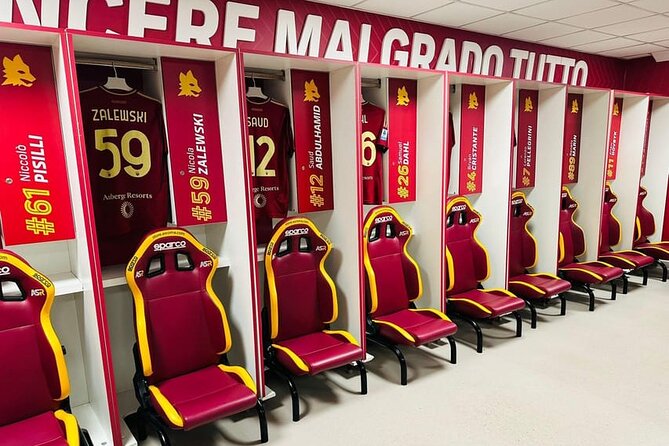
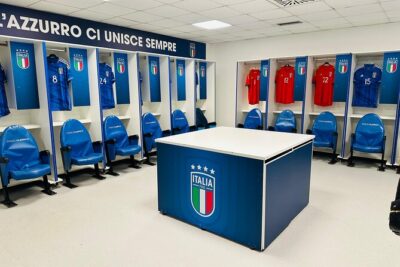
- See private stadium areas: The visit includes the press room, locker room, Hall of Triumph, and VIP areas, subject to stadium access.
- Expect a history lesson as well as football: The tour explains the complex’s 1930s origins, Mussolini Obelisk, and links to Italian sport.
- Meet at the Obelisk, not simply any stadium entrance: The start point is P.zza Lauro de Bosis, beside the 36-meter monument.
- Plan for about 80 minutes: The outdoor section lasts about 10 minutes, with roughly an hour inside the Olympic Stadium.
The Foro Italico begins with marble and political history
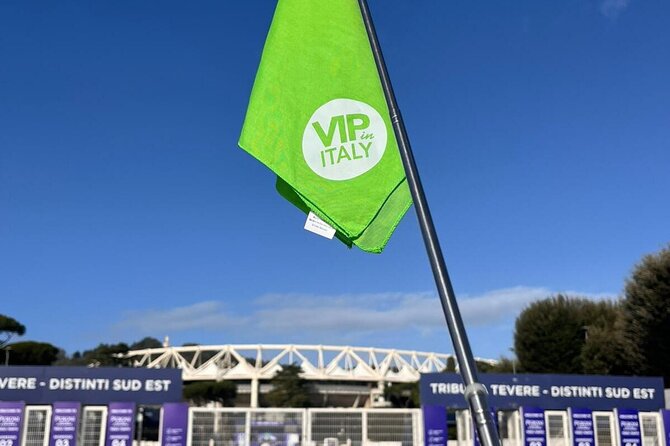
The tour starts at the Mussolini Obelisk in Foro Italico, at P.zza Lauro de Bosis. This meeting point matters. The stadium is large, and a taxi may drop you on the wrong side, so do not assume the nearest stadium entrance is the correct place to begin.
The obelisk rises 36 meters and is made of Carrara marble. It was built as a symbol of Fascist power, and the guide uses it to explain the setting before the group enters the stadium. That context gives the visit more weight than a simple look behind the scenes at a football ground.
The Foro Italico was built in the 1930s as a monumental sports complex. Its architecture was designed to make sport feel grand, public, and tied to national identity. You see that message clearly in the statues, broad avenues, and imposing stonework.
This is one of the tour’s strongest features. You are not being taken straight into a modern arena and shown a few changing rooms. You first see the political and architectural setting that shaped the site.
More Stadium Tours in Italy
- Rome: Colosseum Underground and Arena Tour
★ 4.7 · 1,002 reviews - Rome: Private Colosseum Arena Tour With Roman forum Access
★ 4.5 · 94 reviews - Colosseum Arena tour with Roman Forum and Cesar’s Palace
★ 4.0 · 54 reviews
Stadio dei Marmi and its 60 marble figures
The first stop is the Stadio dei Marmi, an impressive stadium made almost entirely of white Carrara marble. Sixty statues of athletes, each about four meters high, circle the stadium in crowns.
The statues were donated by different Italian provinces. Together, they represent athletic perfection and national unity. Their poses are idealized, with the human body treated almost like part of the architecture.
You have about 10 minutes here. That is enough to admire the repeated figures and take photographs, but it is not a long museum visit. I would pay attention to the guide’s explanation rather than simply walking around the statues. The meaning of this place is tied to how sport was presented in Italy during the 1930s.
The Stadio dei Marmi also gives you a useful visual contrast. The marble figures are still, formal, and carefully arranged. The Olympic Stadium nearby is built for crowds, noise, competition, and movement. Seeing both helps you understand how the Foro Italico combines grand design with active sport.
If you have little interest in football, this opening section may be the part that makes the tour worthwhile. It connects architecture, politics, sport, and public art in one compact area.
Entering the Olympic Stadium through the athletes’ gate
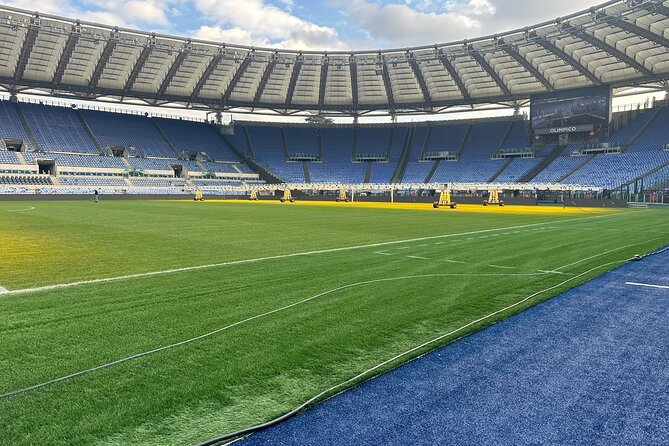
The main stadium visit begins at the Monte Mario gate and the official athletes’ entrance. From there, you follow the route used by players rather than entering through an ordinary public gate.
The most memorable moment for many people is the tunnel leading toward the field. You walk through the same kind of passage where athletes wait before entering in front of a crowd. It is a simple experience, but the setting gives it real atmosphere.
The stadium is home ground for Roma and Lazio, two clubs with a major place in Rome’s sporting life. The guide explains details connected with those clubs, Italian football, and the wider story of the stadium. The precise areas open to your group can depend on what is happening at the stadium that day.
The planned stadium portion takes about one hour. Added to the outdoor introduction, the full visit lasts around 1 hour and 20 minutes. That makes it easy to fit into a day of sightseeing, though you should allow extra time for finding the meeting point and gathering the group.
Locker rooms, press room, and the Hall of Triumph
The tour is designed around places normally closed to ordinary ticket holders. You visit the locker room, where players prepare before a match, and the press room, where the stadium’s sporting events are discussed and explained to the public.
The Hall of Triumph displays trophies and memorabilia connected with Italian sporting victories. This section adds a national sports angle rather than focusing only on Roma or Lazio.
One useful point to keep in mind is that the Hall of Triumph has not always been included in the same way for every group. One visitor hoped to see more trophies and memorabilia, so the exact presentation may feel shorter than expected. If you are primarily interested in football collections, ask the guide what is open on your date.
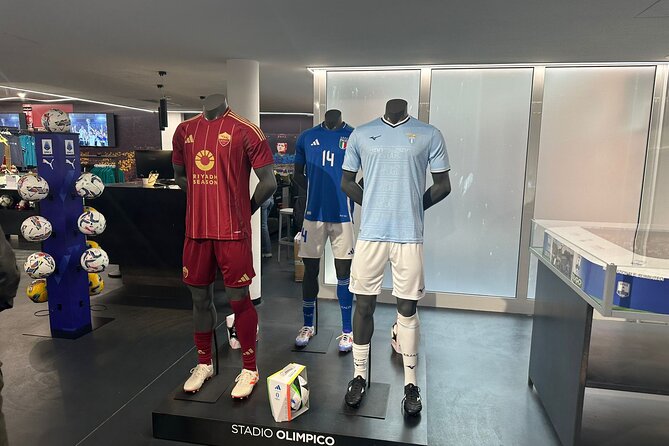
The VIP areas and gift shop may also form part of the route. The shop is a chance to buy a football shirt or other souvenir, but you should not mistake it for part of the historical visit. Bring money only if you want merchandise.
The strongest value here comes from being inside the working stadium, not from seeing a large museum collection. You get a sense of how the building functions around a match or event.
More Stadium Tours in Rome
- Gladiators Arena Tour with Colosseum First Level & Ancient Rome
★ 4.5 · 53 reviews - Olympic Stadium Tour Express- Skip the Line
★ 4.0 · 49 reviews - Private Colosseum Arena Tour with Expert Guide – all inclusive
★ 5.0 · 40 reviews - Rome: Navona Underground & Domitian Stadium Guided Tour
★ 4.6 · 36 reviews
The pitch question: an important booking warning
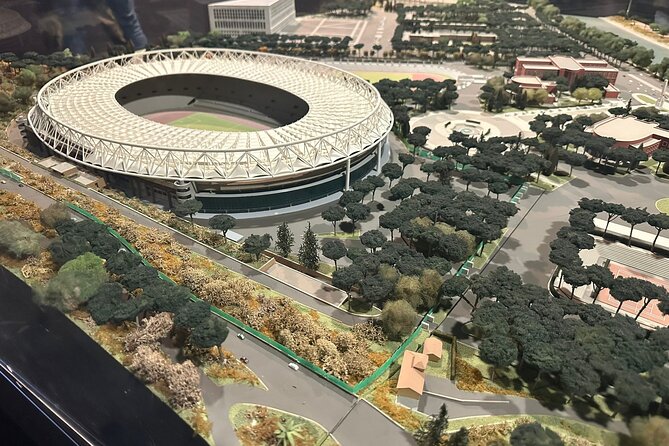
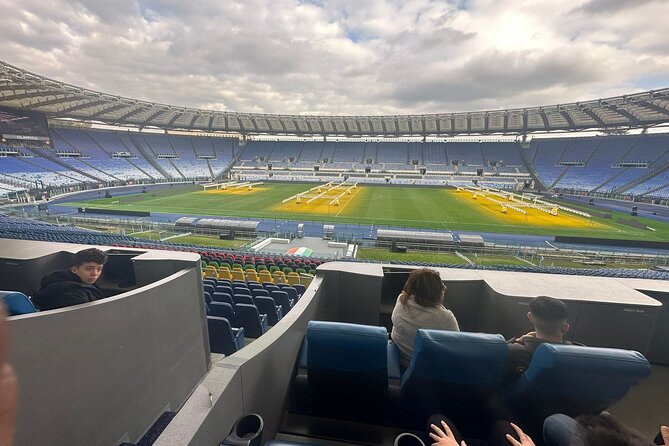
The advertised route leads toward the field, but access to the actual pitch is not guaranteed in every situation. Concerts, preparations for events, or stadium restrictions can alter the route.
One particularly unhappy family had the stadium visit rescheduled after a closure and then found that the pitch and locker rooms were unavailable because of a concert. Their replacement visit focused on the outdoor history, VIP suite, and gift shop. That is a serious consideration if your main reason for booking is to stand beside the field or enter the changing rooms.
I would treat pitch access as dependent on the stadium schedule, not as an absolute promise. If the field and locker room are essential for you, confirm current access before paying, especially if your date is near a concert or major event.
This does not make the tour worthless. The Foro Italico, Stadio dei Marmi, obelisk, tunnel, and stadium architecture remain interesting. But the value changes if the indoor route is reduced, and you should know that before booking.
Guides make the history easier to follow
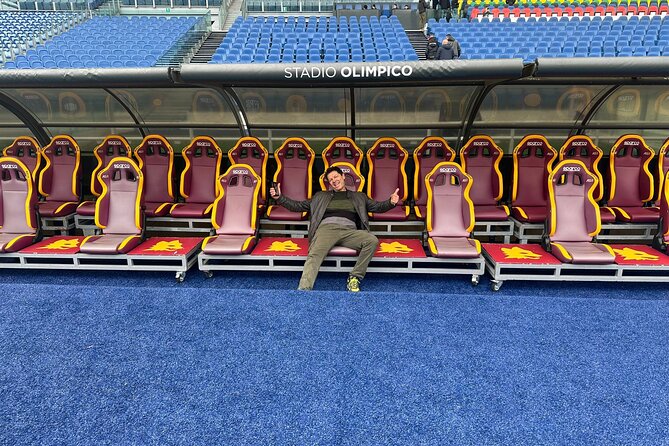
The guide inside the stadium is offered in Italian or English. The outdoor portion is also available in Spanish and French. Since the stadium section is the larger part of the visit, check the language arrangement when you book.
Several guides have received especially warm comments. Angelica is described as friendly, funny, informative, and engaging. Camilla is praised for explaining Roma, Lazio, and the history of Rome. Simone is noted for making the visit worthwhile even for someone interested in more than football.
Beatrice has led the outdoor section and explained the area and stadium history, sometimes with a trainee guide. These names indicate the company uses more than one guide, so you should not expect a particular person unless the booking specifically confirms one.
The best guides connect the site’s present use with its past. That connection matters here because the stadium can otherwise seem like a modern sports venue placed beside old monuments. The guide helps you see how the same location carries several layers of meaning.
The tour is not only for football fans. It can work well for anyone interested in 20th-century architecture, Rome’s public spaces, Italian sporting culture, or the way political symbols remain part of a city’s built environment.
What the $66.37 price buys you
At $66.37 per person, this is not a cheap stadium stroll. Its value depends on what you want from the visit.
The price includes the guided access and the behind-the-scenes route through the Olympic Stadium. You are paying for the guide, the special entry areas, and the chance to walk through the athletes’ entrance and tunnel. For a football fan, that can be a fair price, especially if the locker room, press room, and Hall of Triumph are available.
For a general sightseer, the value is less automatic. Rome has many famous ancient sites, and this tour does not replace a visit to the Colosseum, Roman Forum, or Vatican Museums. Its appeal is specific: modern Italian sport, monumental 1930s architecture, and the atmosphere of a working stadium.
The group can include up to 40 people. That is a fairly large maximum, so do not expect a private tour or a quiet one-on-one conversation with the guide. A larger group may also make it harder to hear in open spaces, though the guide-led format gives you a clear route.
The booking pattern suggests that people often reserve about 32 days ahead. I would not read that as a requirement, but it is a sensible reason to reserve early if your Rome dates are fixed.
Meeting point, transport, and timing
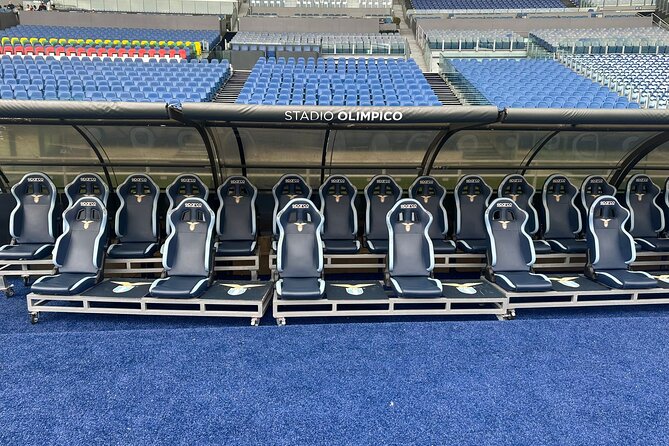
The tour begins at the Mussolini Obelisk, P.zza Lauro de Bosis, 00135 Rome. It ends at the Olympic Stadium on Viale dei Gladiatori. The start and end are in the same broad sports complex, but they are not necessarily the same spot.
The most useful practical tip is simple: identify the large obelisk before you arrive. Several people have become confused by the size of the stadium or by being dropped at a side entrance. A taxi driver taking you near the stadium does not mean you are at the correct meeting place.
The area is near public transportation. The information provided does not specify a particular bus, tram, or metro route, so check the route from your hotel on the day. Allow time to walk from your drop-off point to the obelisk.
A mobile ticket is provided, and confirmation arrives at booking. You can cancel for a full refund up to 24 hours before the start time. Cancellations or changes made less than 24 hours before the experience are not accepted for a refund.
Who will enjoy this stadium visit most
I would recommend this tour most strongly to:
- Football fans who want to see the Olympic Stadium beyond the public seating areas
- People interested in Roma, Lazio, and Italian sporting culture
- Visitors curious about Fascist-era architecture and public monuments
- Families with older children who enjoy sports and behind-the-scenes spaces
- Repeat visitors to Rome who want something different from the ancient center
It is less suitable if you want a long museum visit or a guaranteed walk onto the pitch. It may also disappoint you if you expect a vast collection of trophies or player memorabilia.
Most people can participate, and the maximum group size is 40. The available information does not give detailed mobility guidance for every area, so contact the provider if you need specific access information.
Children’s pricing needs attention. Children from 0 to 5 enter free, while children from 6 to 16 require a reduced ticket. The provider has charged an additional amount when a child was initially booked as age 0 to 5 but later identified as an adolescent, so enter each child’s correct age when booking.
Should you book the Olympic Stadium Tour?
Book it if you want Rome through the lens of Italian sport, monumental architecture, and modern political history. The Stadio dei Marmi, the Mussolini Obelisk, the players’ route, and the tunnel give the tour more substance than a standard stadium photo stop.
I especially like that the visit begins outdoors. You first learn why the Foro Italico looks the way it does, then enter the stadium with that context in mind. The guide quality appears to be a major part of the experience, with Angelica, Camilla, Beatrice, and Simone each praised for clear and engaging explanations.
Before you commit, confirm what areas will be open on your date. If a concert or match preparation blocks the pitch or locker room, the tour may become mostly an outdoor history walk plus VIP areas and the shop. For a football fan who wants guaranteed field access, that uncertainty is the main weakness.
For everyone else, I would book this as a focused 80-minute experience rather than a full sports museum. Meet at the obelisk, not the nearest stadium gate, and you will begin with a much better chance of enjoying what this unusual corner of Rome has to offer.
FAQ
Where does the Olympic Stadium Tour begin?
It begins at the Mussolini Obelisk at P.zza Lauro de Bosis, 00135 Rome.
Where does the tour end?
The tour ends at the Olympic Stadium on Viale dei Gladiatori, 2, 00135 Rome.
How long does the experience last?
The experience lasts approximately 1 hour and 20 minutes. The Stadio dei Marmi visit takes about 10 minutes, and the Olympic Stadium portion takes about one hour.
What language is the stadium tour offered in?
The guide inside the stadium is available in Italian or English. The outdoor section is also available in Spanish and French.
Does the tour include the locker room and pitch?
The planned route includes the locker room and the tunnel leading toward the pitch, but access can change because of concerts, matches, or other stadium events. Actual pitch access is not guaranteed.
What can I see inside the Olympic Stadium?
The route can include the official athletes’ entrance, players’ tunnel, locker room, press room, Hall of Triumph, trophies, memorabilia, and VIP areas. The areas available can depend on stadium operations.
Is the tour suitable for people who are not football fans?
Yes. The tour also covers the Foro Italico, 1930s architecture, the Stadio dei Marmi, the Mussolini Obelisk, and the history of the stadium.
How many people can join the tour?
The maximum group size is 40 people.
Can I cancel for a refund?
Yes. You can cancel up to 24 hours before the experience start time for a full refund. Changes or cancellations made less than 24 hours before the start time are not accepted for a refund.
More Olympic Venues in Rome
- Tickets and Guided Tour of the Olympic Stadium in Rome and Foro Italico
★ 4.5 · 404 reviews - Berlin: Olympia Stadium Entrance Ticket
★ 4.3 · 789 reviews - The Olympic Museum Entrance Ticket in Lausanne
★ 4.5 · 211 reviews - Barcelona: City Center and Olympic Park GoCar Experience
★ 4.8 · 146 reviews
Just added for fans in Rome
- Guided Group Tour of Colosseum with Arena Floor★ 4.5 · 18 reviews
- Rome: Navona Underground and Domitian Stadium Guided Tour★ 4.5 · 8 reviews
- Rome : Colosseum Underground and Arena Tour (MAX 7 PEOPLE)★ 5.0 · 17 reviews
- Rome: Join a AS Roma or Lazio football match with Local★ 5.0 · 2 reviews
- Small-Group Rome Tour by Golf-Cart★ 5.0 · 2 reviews
- Exclusive Private Golf Cart Tour of Rome★ 5.0 · 5 reviews
- Private Colosseum Arena Tour with Expert Guide – all inclusive★ 5.0 · 40 reviews
- Rome Golf-Cart Rental★ 5.0 · 35 reviews
Olympic Venues, compared.
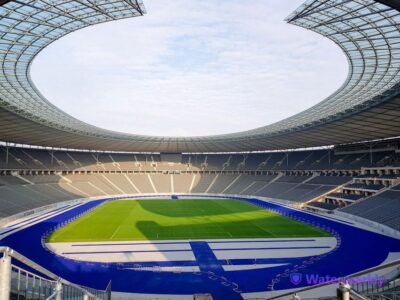
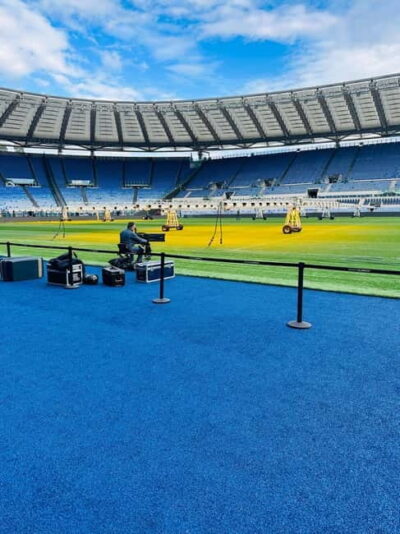
Tickets and Guided Tour of the Olympic Stadium in Rome and Foro Italico
Read our review →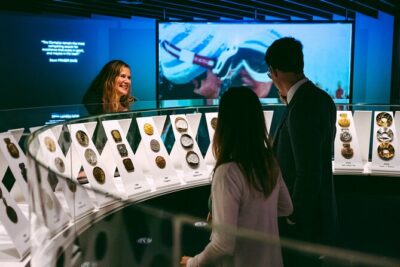


Maihaugen Museum/The Norwegian Olympic Museum, Lillehammer.
Read our review →Browse the lists this tour appears in