
Review · SUMO EXPERIENCES IN TOKYO
Sumo Morning Training Watch in Tokyo,Hotel-pickup w/English guide
Professional sumo training is not a staged show. You sit close to the ring inside a working stable and watch wrestlers build strength, repeat techniques, and face one another in serious practice bouts. I especially like the genuine behind-the-scenes setting and the fact that your English-speaking guide can explain what you are seeing without breaking the stable’s quiet.
Hotel pickup also takes the stress out of finding an unfamiliar stable, and guides such as Koichiro, Hiromi, Mari, Midori, and Hiro have helped make the morning personal and easy to follow. The main consideration is that pickup does not mean private transport: you may travel by subway and bus, and the tour begins early at 7:30 a.m. The stable can also be quiet and cramped, with no talking during training.
Key points to know before booking
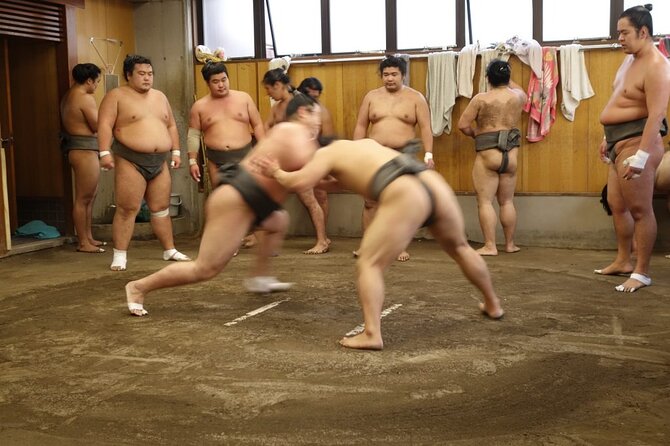
- Watch real morning practice from very close range: You may sit only a few feet from the wrestlers as they stretch, drill, and compete.
- Hotel pickup is included: Your guide meets you at your hotel and handles the route to the stable by public transportation when needed.
- English explanations add real value: Guides explain sumo rules, rituals, rankings, training methods, and what is happening during silent practice.
- Photos may be possible after training: Some sessions include a chance to take pictures with wrestlers, but this depends on the stable and schedule.
- The tour is small and early: It lasts about three hours, begins at 7:30 a.m., and accepts up to 15 people.
- Plan around stable closures: The experience is unavailable from May 10 to June 5, June 26 to August 6, September 13 to October 8, and October 23 to December 3 in 2025.
Sitting beside the dohyo in a working stable
The best part of this experience is the distance between you and the action. You are not watching professional sumo from a large arena with thousands of people around you. You are inside a sumo stable, close to the training ring, watching wrestlers prepare for competition.
The morning usually begins with basic exercises. Wrestlers work their legs, hips, and upper bodies through repeated movements designed to build power and balance. You may see stretching, strength work, and practice drills before the more forceful bouts begin.
Then come the practice matches. Two wrestlers face one another at a time, pushing, throwing, and trying to force the other from the ring. The action can be surprisingly physical at such close range. Even if you know little about sumo, you can see that this is serious training, not a performance arranged for tourists.
The session may last around 90 minutes to two hours, depending on the stable and the day. The tour itself lasts about three hours, allowing time for pickup, transportation, explanations, and the return portion of the outing.
One important point: silence matters inside the stable. You should not expect a running commentary during every bout. In some groups, the guide explains things before or after practice. During training, guides may use paper, pens, handouts, or a small writing board so you can ask questions without disturbing the wrestlers.
That quiet is part of the experience. You hear the impact of the wrestlers, the movement around the ring, and the instructions from the stable. It feels less like a public performance and more like being allowed to observe a private working routine.
More Sumo Experiences in Tokyo
- Tokyo: Sumo Show and Dining Experience
★ 4.8 · 2,742 reviews - the SUMO show
★ 5.0 · 1,960 reviews - Tokyo Shinjuku Sumo Show & Experience with Photo
★ 5.0 · 1,750 reviews
What your 7:30 a.m. pickup really includes
Your guide meets you at your hotel at the arranged time. The exact pickup area is not specified, so you should provide clear hotel details when booking and watch for confirmation, which is sent within 48 hours and remains subject to availability.
The route to the stable is often by train, subway, or bus rather than a private vehicle. That distinction matters. Hotel pickup gives you a person who knows the route, not necessarily a car waiting outside. Guides have helped visitors manage public transportation, transfers, and the final walk to a facility that can be difficult to locate alone.
Bring a loaded Suica or other usable transit card if your guide asks you to pay for transportation separately. The tour information does not list transport fares as an included item, so confirm the arrangement at booking. Good walking shoes are a smart choice, especially in wet weather or if the route includes a longer walk.
This part can be one of the tour’s strongest practical features. Sumo stables are working facilities, not standard sightseeing attractions with large signs and ticket desks. An English-speaking guide can get you there on time and help you understand local etiquette before you enter.
The tradeoff is that you do not return to your hotel as part of the standard package. Hotel drop-off is not included. Your guide may help you reach a train station or your next destination, and some guides have added a short visit to a nearby shrine, temple, supermarket, or neighborhood along the way. Treat those extras as dependent on timing and the individual guide, not as fixed stops.
The guide changes how much you see
Without explanation, sumo training can be fascinating but hard to decode. You will see men in traditional practice settings performing movements that may look repetitive. A good guide helps you understand why they are stretching, what a particular drill develops, and how a practice bout differs from a tournament match.
The guides associated with this experience include Koichiro, Sumi, Hiromi, Atsushi, Tadashi Umebayashi, Yuka, Mari, Midori, and Hiro. The exact person depends on the date and group, but the strongest guiding style is clear from the way the outing is structured: background before training, quiet visual help during the session, and time for questions afterward.
Koichiro has been praised for his passion for sumo and for explaining small details, including which wrestlers show promise. Hiro has used a dry erase board during bouts, letting the group ask many questions without making noise. Other guides have supplied printed notes, sketches, and written explanations.
That support is especially useful if you have never watched sumo. You can ask about the rules, the rituals, the wrestlers’ roles, or the meaning of the warmups. You also get a chance to ask broader questions about Japan during the train ride, though the quality and amount of extra sightseeing depend on your guide and the day.
There is one fair warning. A guide is not automatically a great interpreter. At least one booking received only a basic sheet of stable rules, with little explanation during the session. If you want more context, ask questions before training starts and again afterward. The more specific your questions, the more useful the experience is likely to be.
Reading the rituals, drills, and practice bouts
Sumo is more than two athletes pushing in a ring. The training session gives you a look at the discipline behind the short bouts seen in tournaments.
The opening exercises focus on strength and movement. You may see work aimed at the legs, hips, and upper body, along with routines that build muscle and control. These exercises can appear slow at first, but their repeated nature makes the physical demand clear.
The practice bouts are the most dramatic part. Wrestlers test balance, timing, grip, footwork, and force. You may also see a stable master or senior figure correct a wrestler or speak to him after a mistake. Because you are near the ring, small movements are easier to notice than they would be from arena seating.
Your guide can point out who is training, which techniques are being used, and what to watch for. During one session, a guide identified wrestlers and explained important moments through notes so the group could remain quiet.
Do not expect a fixed show with a guaranteed order. The training schedule depends on the stable, its wrestlers, and the tournament calendar. Some mornings may feel more active than others. During a tournament period, training may be lighter, and wrestlers may have more time to interact after practice.
This variation is part of the value, but it also means you should not book expecting a particular wrestler, exact number of bouts, or guaranteed photo session.
Same city, a different fixture:
- Tokyo: Sumo Show and Experience in Shinjuku
★ 4.8 · 1,001 reviews - Tokyo Grand Sumo Tournament Viewing Tour with Tickets
★ 5.0 · 692 reviews - Tokyo Sumo Wrestling Tournament Experience
★ 5.0 · 660 reviews - Tokyo:Luxury Sumo Show Experience & Japanese cuisine & Drink
★ 4.7 · 577 reviews
Photos with wrestlers after practice
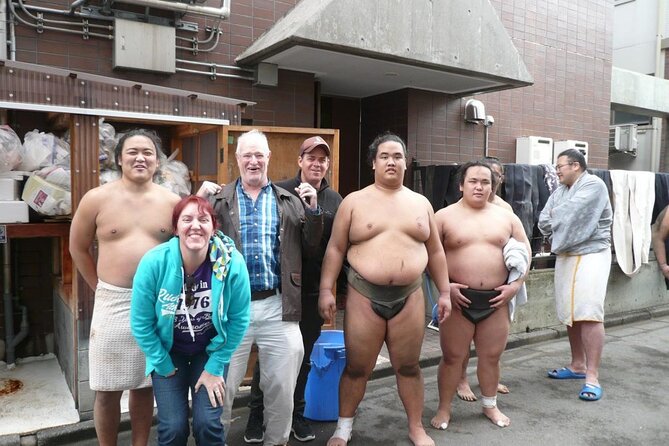
After training, you may have a chance to take pictures with one or more wrestlers. Several outings have included photos, and guides have sometimes arranged for a wrestler to join the group once practice ended.
This can be a memorable close to the morning, but it is not guaranteed. The schedule, stable, and wrestlers’ availability control what happens next. The tour description specifically says the photo opportunity depends on the session and stable.
Keep your expectations polite and flexible. You are visiting a working training space, and the wrestlers may need to continue with their routines. The possibility of a photo is a welcome extra, not the main reason to book.
If you hope to take pictures, have your phone or camera ready and follow your guide’s instructions. Photography during practice may be allowed in some way, but the stable’s rules come first. Do not assume that flash, conversation, or moving close to the ring will be acceptable.
Comfort, seating, and the early start
The physical setup is simple. You may sit on cushions beside the ring, with low chairs sometimes available. Those chairs are still close to the floor, so anyone with knee, hip, or mobility concerns should think carefully before booking.
The tour information says most people can participate, but it does not promise a fully accessible facility. The stable is a working place rather than a purpose-built visitor center. Ask the provider about your specific needs before paying if you have difficulty sitting low, standing up, walking, or using stairs.
The 7:30 a.m. start also affects your day. You need to be ready at the hotel early, and the public transportation portion takes time. I like this timing because it places you inside the stable during its natural morning routine, but it is not ideal after a late arrival or a night of poor sleep.
Wear comfortable shoes and dress for a morning that may include outdoor walking, train platforms, and time spent sitting quietly. Food and drinks are not included, so eat beforehand or plan to find breakfast after the tour. Do not count on a stop during the stable visit.
The group maximum is 15 people. That is small enough for questions and personal guidance, though the feel can change depending on the final group size. Some outings have been nearly private, while others may include a larger group.
Is $159.88 a fair price?
At $159.88 per person, this is not a cheap morning activity. You are paying for access to a real stable, a licensed English-speaking guide, hotel pickup, route planning, cultural interpretation, and the chance to watch professional training from close range.
The value is strongest if you would struggle to find the stable, manage the transit, or understand what is happening without help. Sumo practice is not as simple to follow as arriving at a ticketed stadium. The guide can explain customs, rules, training methods, and etiquette while taking care of the practical details.
The price is less appealing if you are already comfortable navigating Tokyo, speak Japanese, and mainly want to watch from outside. The tour does not include food, hotel drop-off, or guaranteed photos. Public transit costs may also need to be handled separately.
I would view the guide as the main value, not just the pickup. A strong guide can turn a quiet training session into a lesson in sumo and Japanese culture. Ask plenty of questions, especially before and after practice, to get the most from the fee.
Who should book this sumo morning?
I would recommend this experience to anyone with even a passing interest in sumo who wants to see the sport away from a tournament arena. It is also a good choice for first-time visitors who want a structured introduction and do not want to search for an unfamiliar stable alone.
Families and older adults may enjoy the short duration and small group, but low seating and early transportation deserve thought. People with knee or hip problems should ask about the stable’s seating before booking.
This is less suitable if you need a fully fixed itinerary, guaranteed wrestler contact, or a private car. It is also not the right choice if you expect nonstop explanation inside the stable. Silence is part of the etiquette, and some instruction happens through notes or after training.
Book well ahead if your schedule is fixed. The experience is often reserved about 57 days in advance, and confirmation is subject to availability. Also check the closure dates carefully: in 2025, no sessions are offered from May 10 to June 5, June 26 to August 6, September 13 to October 8, or October 23 to December 3.
Free cancellation is available up to 24 hours before the start time for a full refund. Changes or cancellations inside that 24-hour window are not accepted or refunded.
Should you book it?
Book this tour if you want close, authentic sumo training and would value an English-speaking guide to handle the route and explain the sport. The chance to sit beside the ring, watch real drills and bouts, and possibly meet wrestlers afterward is unusual in Tokyo.
I would skip it only if the price feels high for a three-hour outing, low seating is a concern, or you prefer to make your own way around the city. For most visitors who want more than a quick photo outside a stadium, the access and guidance make the cost reasonable. Bring good shoes, prepare for an early morning, and treat the photo opportunity as a bonus.
FAQ
What time does the sumo morning training tour start?
The stated start time is 7:30 a.m. Your guide meets you at your hotel for pickup.
How long does the experience last?
The tour lasts approximately three hours. The training session itself may run for about 90 minutes to two hours, depending on the stable and schedule.
Is hotel pickup included?
Yes. Hotel pickup with an English-speaking guide is included. Hotel drop-off is not included.
How do I get to the sumo stable?
The route may involve public transportation such as the subway, train, or bus, along with walking. The guide handles the route and helps you reach the stable.
Will I be able to take photos with the wrestlers?
You may have a chance to take photos with wrestlers after training. This depends on the stable and the day, so it is not guaranteed.
Is food or drink included?
No. Food and drinks are not included in the tour.
How many people can join the tour?
The maximum group size is 15 people. Confirmation is sent within 48 hours of booking, subject to availability.
Just added for fans in Tokyo
- Tokyo: Grand Sumo Morning Training Tour★ 4.9 · 12 reviews
- Sumo Training Watching Experience in Tokyo★ 4.5 · 8 reviews
- Kickboxing & Body Training with EX-Pro Fighter★ 5.0 · 4 reviews
- Tokyo: Visit Sumo Morning Practice with English Guide★ 4.5 · 22 reviews
- Tokyo Sumo Experience with Live Show & Audience Challenge★ 5.0 · 38 reviews
- 【SUMO FESTIVAL】Tokyo Ginza: Sumo Show & Photo Experience★ 4.5 · 41 reviews
- Tokyo Shinjuku Sumo Show and Experience with Drinks and Photo★ 4.0 · 21 reviews
- Tokyo Sumo History Tour with Chanko Nabe Lunch★ 5.0 · 3 reviews
Sumo Experiences in Tokyo, compared.
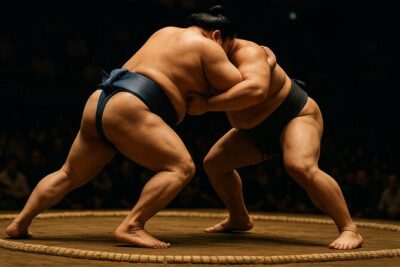
Tokyo Shinjuku Sumo Show & Experience with Photo
Read our review →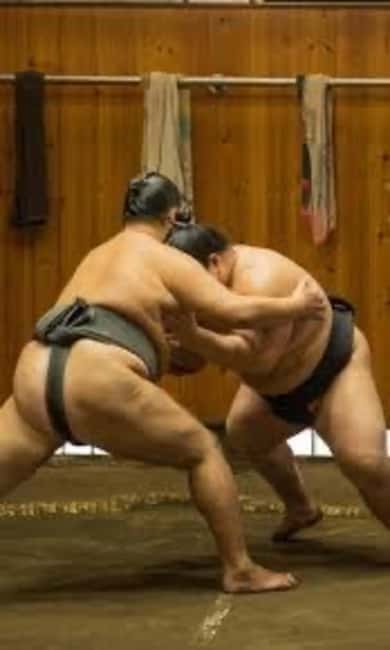
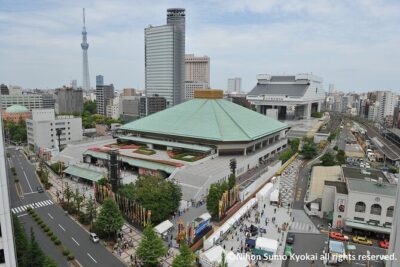
Tokyo Grand Sumo Tournament Viewing Tour with Tickets
Read our review →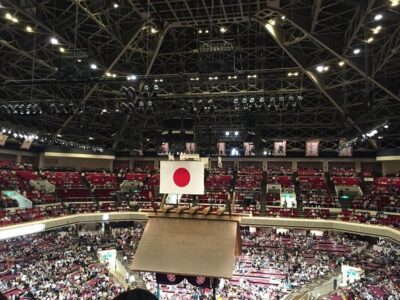

Luxury Sumo Show Experience & Japanese cuisine & Drink
Read our review →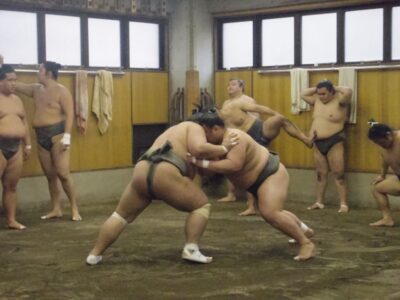
Browse the lists this tour appears in